
*This content was translated by AI.
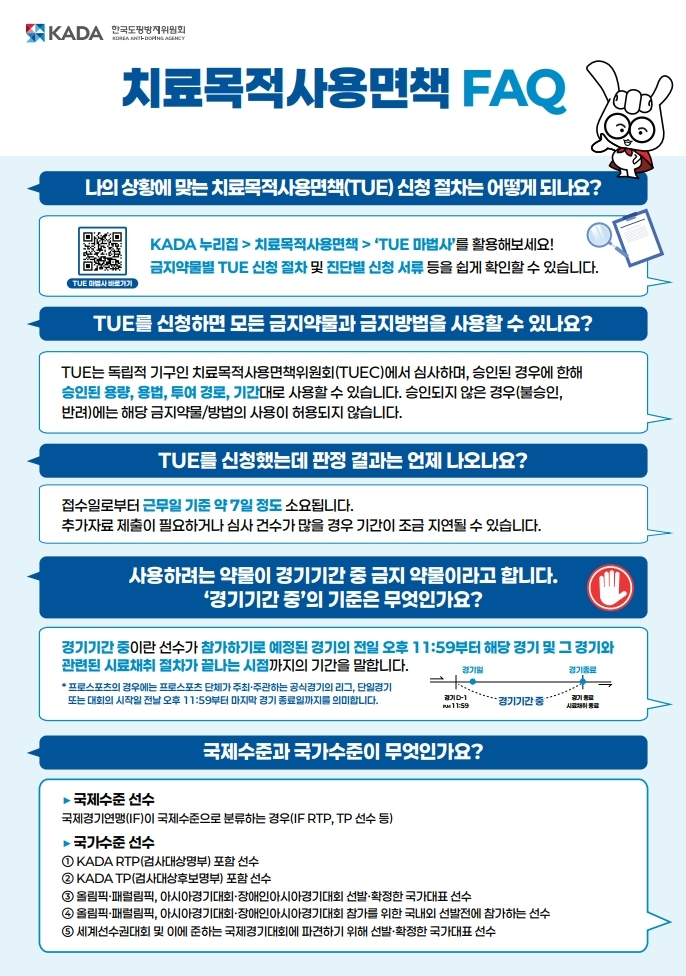
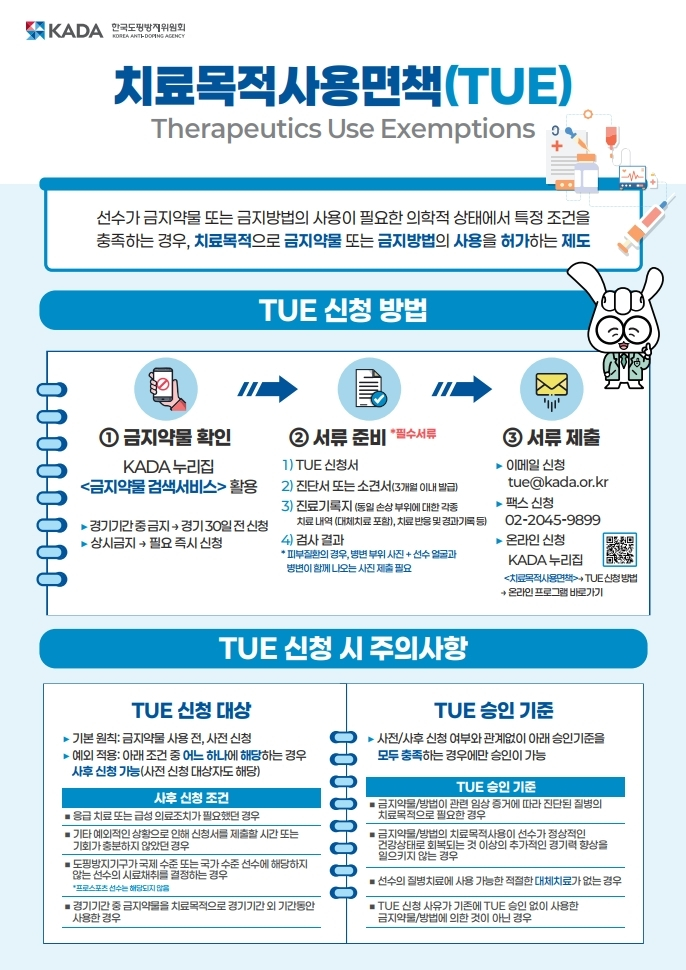
The Korea Anti-Doping Committee (Chairman Yang Yoon-jun, hereinafter KADA) operates a Therapeutic Use Exemption (TUE) system at all times to protect athletes' health and create a fair sports environment. Through this, we are supporting an environment where players can be safely treated.
"The TUE system allows exceptions even if it is a drug or method prohibited under anti-doping regulations when the use of the drug or method is medically inevitable to treat disease or injury," KADA said. "It aims to substantially protect the 'right to treatment' guaranteed to athletes and to maintain a fair sports environment by preventing the indiscriminate use of banned drugs."
"The KADA Treatment Use Exemption Committee (TUEC), an independent deliberation body composed of sports medicine and clinical specialists, is in charge of screening these TUE applications, and deliberations are conducted professionally and objectively based on the 'World Anti-Doping Code' and the 'International Standard for Treatment Use Exemption,'" he added.
"KADA TUEC has reviewed a total of 196 TUE applications in the past 2025 year. Among them, 142 cases of medical validity were approved, and athletes who were forced to use banned drugs for treatment were supported to receive treatment stably in accordance with regulations. On the other hand, for 54 cases that did not meet the approval criteria, the rigor and fairness of the system were maintained through disapproval and return decisions.
According to KADA, applications for glucocorticoids (S9) were the most common in 2025, followed by 27 for stimulants (S6), 21 for drugs (S7), and 15 for peptide hormones, growth factors, and similar drugs (S2).
By disease classification, musculoskeletal diseases accounted for the highest proportion with 73 cases, followed by neurological and psychiatric diseases such as ADHD (38 cases), endocrine diseases such as growth hormone deficiency and diabetes (26 cases), and skin diseases such as allergies (22 cases).
Lee Seung-rim, chairman of KADA TUEC, emphasized, "Athletes should not avoid necessary treatment or miss the time due to vague concerns about doping violations," adding, "If medical necessity is proven, they can be safely treated according to the established procedures through the TUE system, so please actively utilize the system."
Meanwhile, KADA Secretary-General Kim Il-hwan said, "Based on the results of a survey on inconveniences related to the TUE system implemented in 2025, we plan to reorganize the TUE information page on the website and strengthen public relations to make it easier for athletes and athletes to understand and utilize the TUE system," adding, "We plan to continue supporting athletes' health by actively guiding them to the site of the 'Prohibited List International Standard' that has been applied since January 1, 2026."
<© STARNEWS. All rights reserved. No reproduction or redistribution allowed.>
*This content was translated by AI.



![Iran Air Raid Damage → "I can't get in touch with my family," so I only think of spring volleyball, a more grateful foreigner' [the scene of Incheon]](https://image.starnewskorea.com/cdn-cgi/image/f=webp,w=1200,h=800,fit=cover,g=face/21/2026/03/2026030707183024337_1.jpg)


![Even if it's later, I feel more pressure' Panama Defeats Cuba 1-3... Venezuela-Mexico 'side by side' European team win outright [2026 WBC]](https://image.starnewskorea.com/cdn-cgi/image/f=webp,w=1200,h=800,fit=cover,g=face/21/2026/03/2026030704542215289_1.jpg)


