*This content was translated by AI.View Original

The total prize money for the 2026 FIFA North American World Cup is 968 billion won, a 50% increase compared to the 2022 Qatar tournament. The champion team will receive 73.9 billion won from FIFA. All 48 teams that qualify for the finals are guaranteed a base prize of 15.5 billion won.
If South Korea achieves at least a draw against South Africa in their final group stage match on the 25th (Korean time) and advances to the Round of 32, they will secure 19.2 billion won. From an economic perspective, the World Cup has now evolved into a global competition for national teams to win prize money.
To earn more prize money, teams must perform well on the field. While performance encompasses many aspects, one area receiving particular attention in the North American World Cup is the racial diversity of players across national teams.
This World Cup is being called the "Diaspora (Migrant) World Cup." According to a report by the British weekly economic magazine The Economist on the 10th, as many as 24% of all players participating in the 48th final tournament teams were born abroad. This figure represents a record high, marking a 15 percentage point increase compared to the 9th% recorded at the 1994 U.S. World Cup.
In addition, squads for national teams include a large number of players from immigrant generations. Including these players, approximately 30% of all participants in the World Cup can be considered multicultural athletes.
For instance, in Curaçao, players born abroad account for as much as 96%. Cape Verde, which has recently drawn with Spain and Uruguay to become a team of interest, also has a 65% rate of players born outside the country.
Furthermore, Morocco, which reached the semifinals in the previous Qatar World Cup, has 19 out of its 26 players for the North American World Cup squad born abroad. Many of these players were born in France and Spain, former colonial powers that divided Morocco. This is why Moroccan football, which continues to show strong performance by drawing with Brazil in this tournament, is described as a "product of the diaspora."

France, which has reached the final four times in the last seven World Cups and won twice, is a European country with an unusually high number of players of African descent. Among the French national team players participating in the North American World Cup, 21 have ancestry from African or Caribbean coastal nations.
France is also referred to as a "factory" for producing national team players for various countries competing in the North American World Cup. This is because 76 players of diverse ethnic backgrounds born in France are currently representing countries such as Algeria and Senegal.
Interestingly, racial diversity within national teams significantly impacts performance. According to a paper published in December 2022 by the School of Public Policy at George Washington University in the United States, an increase in the number of foreign-born players on World Cup national teams correlates with a higher probability of winning matches during the tournament.
Analyzing data from the 1970 to 2018 World Cups, the study concluded that "for every additional foreign-born player added to a national team, the team can play an average of 0.15 more games in the World Cup."
An analysis published in an economics journal in 2023 reached similar conclusions. The paper found that as racial diversity increases within World Cup national teams, goals scored tend to rise while goals conceded decrease.
Teams with a rich pool of foreign-born players hold an advantage in the World Cup. Selecting players solely from within one's own country is disadvantageous when it comes to securing talent. Moreover, for African teams like Morocco, foreign-born players are crucial because they can utilize athletes who have grown up in Europe, where conditions for becoming professional footballers are more favorable.
Football demands diverse abilities depending on the position. In this regard, European teams such as France, the Netherlands, Portugal, and Germany, which feature a large number of multicultural players, can enhance their competitiveness through strategic squad composition.

In contrast, both South Korea and Japan have a very large number of players based in Europe. Of South Korea's 26-player squad for the North American World Cup, 15 are active in Europe. Meanwhile, Japan's squad consists of 23 European-based players. Since the 2002 Korea-Japan World Cup, the steadily increasing proportion of European-based players in both national teams has played a significant role in improving their overall strength.
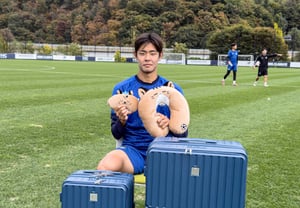
However, South Korea and Japan each have only one multicultural player in their North American World Cup squads. South Korea has Jens Castro (23, Borussia Mönchengladbach), born to a Korean mother and German father, while Japan has goalkeeper Suzuki Zayon (24, Parma), whose father is of Ghanaian descent.
Considering that the North American World Cup is a Diaspora World Cup, the proportion of multicultural players in both teams is relatively low. A contrasting point is that while Japan's Suzuki Zayon continues to be selected as the starting goalkeeper, South Korea's Castro has yet to make his World Cup debut.
Castro has a chance to play in the final group stage match against South Africa. One reason Castro has not been selected so far is concerns about his defensive stability. Given his strong attacking tendencies, Castro often leaves space behind him at his club team.
However, in the match against South Africa, South Korea is likely to adopt an aggressive style of play. In this context, Castro, who is strong in one-on-one duels and excels in linking attacks, could become a new card for coach Hong Myung-bo, who struggled against Mexico.
In past World Cup matches, foreign-born players have played a role in increasing the winning probability of national teams. For this statistic to apply to the match against South Africa, Castro must be on the field rather than on the bench.

<© STARNEWS. All rights reserved. No reproduction or redistribution allowed.>
*This content was translated by AI.View Original